Sourdough bread is the oldest method of making yeast breads. In this method naturally occurring yeast in the flour and the air are captured and cultured on a basic flour-water combination called starter. This starter is then maintained with regular feeds until the yeast provides a perfect environment for lactic acid bacteria. Both lactic acid bacteria and the naturally occurring "wild yeast" then form a symbiotic relationship thus growing together. Such a starter can be maintained
by regularly feeding them and can last as long as one wants. The commercially available yeast cannot survive in this environment. Certain types of bread such as rye-bread (without adding any wheat flour) come out much better with sourdough than commercial yeast. Due, to the presence of lactic acid bacteria, sourdough breads obtains a slightly fermented sour taste leading to an incredibly tasty tangy bread, yum!
Naturally occurring yeast are present in most of the flour we buy. So adding water to the flour and keeping it in a warm place is all that is needed to create a hospitable environment for the yeast to grow which then naturally offers a nice place for the lactic acid bacteria. There are more than one reasons for eating sourdough bread and not the least of them is the yummy sour taste! Sourdough breads have low glycemic index than bread made from commercial yeast. See http://www.simplebites.net/the-health-benefits-of-sourdough-bread-recipe-whole-grain-sourdough-bread/ For the more curious among you I will refer you to http://www.kitchenstewardship.com/2010/03/05/food-for-thought-health-benefits-of-sourdough/ for the health benefits of sourdough. For more information on the techniques and details of sourdough starters and breads, please see,
http://www.sourdoughhome.com/index.php
This time around (yes, I have done this before) my intention was to bake a sourdough rye bread this weekend. So I needed a rye-flour starter (I already have a white bread flour starter). So here is how I made my rye starter...
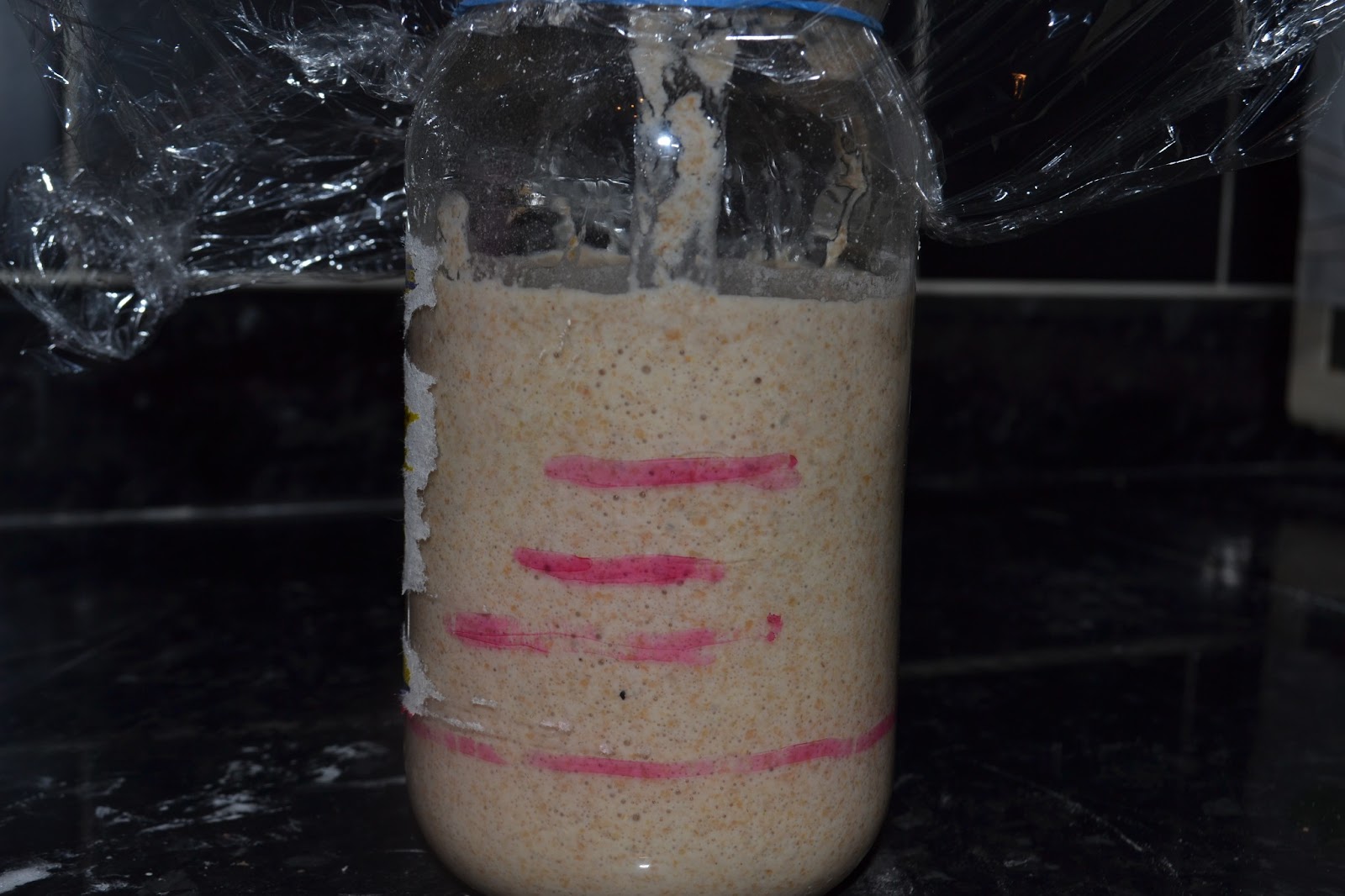
DAY 1 (05/03/2013): I combined 2 generous table spoons (40 grams) of stone ground wholemeal rye flour with 40 grams of water in a clean (well washed, rinsed and sterilised container). I marked the level of my starter with a red permanent marker, covered the top of the container with cling film & rubber band and loosely placed the lid on top. Remember to use a clean spoon to mix the dough at all times. It is very easy to contaminate and introduce other organisms, like mold, into this environment. I keep a wooden chopstick for this use that I never use for anything else.
I left it in the warmest place in my house, i.e., on top of the refrigerator.
DAY 2 (06/03/2013): 24 hrs later, more or less, I felt incredibly lucky to spot a few bubbles in my starter indicating the growth of yeast. This has happened quite quickly for me. It can sometimes take up to 3 days for the wild yeast to start growing in the starter, so, patience is the key. I added another 20 grams of rye flour and 20 grams of water, mixed well, marked the level again and left it back on top of the refrigerator.
DAY 3 (07/03/2013): Another 24 hrs later, on day 3, I could clearly see (below) more bubbles formed by the yeast growth even on the side of the bottle, yay! There was also a slight sour smell indicating the lactic acid bacteria had joined the party! Fed my starter another 20 grams of flour and 20 grams of water, marked the level again and left it to rest.
4 hours later... the level of my starter had nearly doubled indicating my starter indeed was alive and doing well.
DAY 4 (today 08/03/2013): There is a distinct sour smell (like beer) and the top looks very frothy (see below).
So I gave it another feed and saw it come alive after 2 hrs
This probably will be my last feed without taking out any of the old starter. Mainly because I have reached the amount of starter I need, to bake my bread and then have a little bit left for maintaining it for future use, and if I keep adding any more there won't be room for it to grow! So the next time I feed, I will throw away 40 grams of my starter and add 20 grams of flour and 20 grams of water, leave it to rest and then pop it back in fridge after 2-3 hrs.
So this starter is now going to go into to the refrigerator (for storage) until I am ready to bake my bread (this weekend hopefully). This starter can be now maintained indefinitely for the future as long as I feed it regularly: everyday if it is outside (beware that mold can grow if we are not careful) or every other day in the warm part of the refrigerator or every 3 days in the coldest part. The day before I am ready to bake my bread, I will feed the starter a few times (about 4) by throwing away half of the starter and feeding with the exact amount of flour and water I removed. I will then use as much starter as I need for the bread (according to the recipe) and then replenish my starter by the same amount and leave it back in the fridge for future use. Pretty much this is my own personal yeast source that I can pretty much use it for making anything from bread to pizzas to pancakes, awesome!
Note:
- The starter is incredibly easy to make, but, it is not exactly guaranteed. It may take more or less time and the results may vary depending on the environment and a lot of factors.
- There are lot of advice against using starters that are less than a week old. But I have not had any problem before. Being a Physicist who works in Biological Sciences, I am pretty convinced that the symbiotic relationship between yeast and lactic acid bacteria once established will create an environment that may not be suitable for other organisms. Even if there is anything else, harmful growing, I am sure it will be killed at the cooking process. However, I leave it to your discretion.
- There are many different techniques to make sourdough. But I found this one the simplest and easiest to follow.
- Some people claim that the chlorine in the tap water kills the yeast and suggest using filtered water. But I have so far never had a problem with using tap water to make sour dough.
Update (over the weekend on 11/03/2013)):
I have kept the starter in the fridge. But took it out on 10/03/2013 and threw away 80 grams of the starter and replaced/fed it again with 40 grams of rye flour and 40 grams of water. I left the starter outside for 4 hrs and put it back in the fridge. On Sunday (10/03/2013) when I took it out of the fridge, to feed, the starter had a clear liquid on the top that had separated and smelled fantastic with sour taste (See left side pic). Wish you could smell it too! Anyway, the starter is now "ripe" and perfect for making sourdough bread. I had planned on baking sourdough bread this weekend. But it turned out that yesterday was Mothering Sunday and I had enough on my plate to worry about sourdough bread. So I just plan on continuing with the feeding every other day and bake the sourdough bread at the next chance I get. So please bear with me :)